Slides and Transcript
Slide 1 of 22
So we're going to continue to explore the science of the art of pharmacotherapy focusing in this lecture on the pharmacotherapy alliance, the involvement of the patient in their own treatment, taking it seriously their own treatment preferences and also thinking about the ways that we communicate with our patients.
Slide 2 of 22
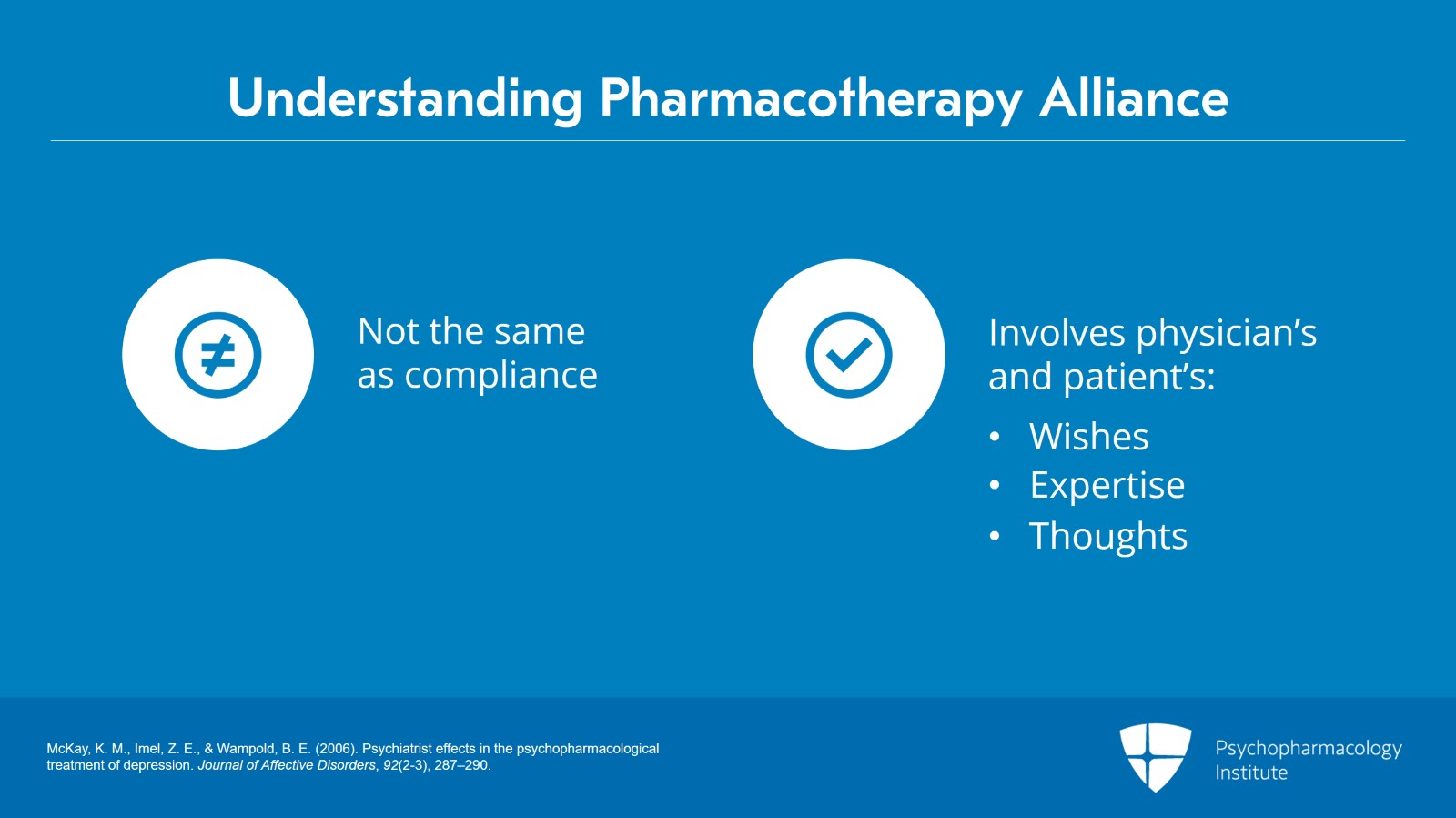
So first of all, to say alliance is not the same thing as compliance. Alliance is a negotiated position that involves both our wishes and expertise and the patient's wishes and patient's expertise about themselves and some negotiated position that really tries to take into account the thoughts of both clinician and patient.
References:
- Krupnick, J. L., Sotsky, S. M., Simmens, S., Moyer, J., Elkin, I., Watkins, J., & Pilkonis, P. A. (1996). The role of the therapeutic alliance in psychotherapy and pharmacotherapy outcome: Findings in the National Institute of mental health treatment of depression collaborative research program. Journal of Consulting and Clinical Psychology, 64(3), 532-539.
Free Files
Download PDF and other files
Success!
Check your inbox, we sent you all the materials there.
Slide 3 of 22
Alliance as I'm suggesting is directly correlated with treatment response.
References:
- Krupnick, J. L., Sotsky, S. M., Simmens, S., Moyer, J., Elkin, I., Watkins, J., & Pilkonis, P. A. (1996). The role of the therapeutic alliance in psychotherapy and pharmacotherapy outcome: Findings in the National Institute of mental health treatment of depression collaborative research program. Journal of Consulting and Clinical Psychology, 64(3), 532-539.
Slide 4 of 22
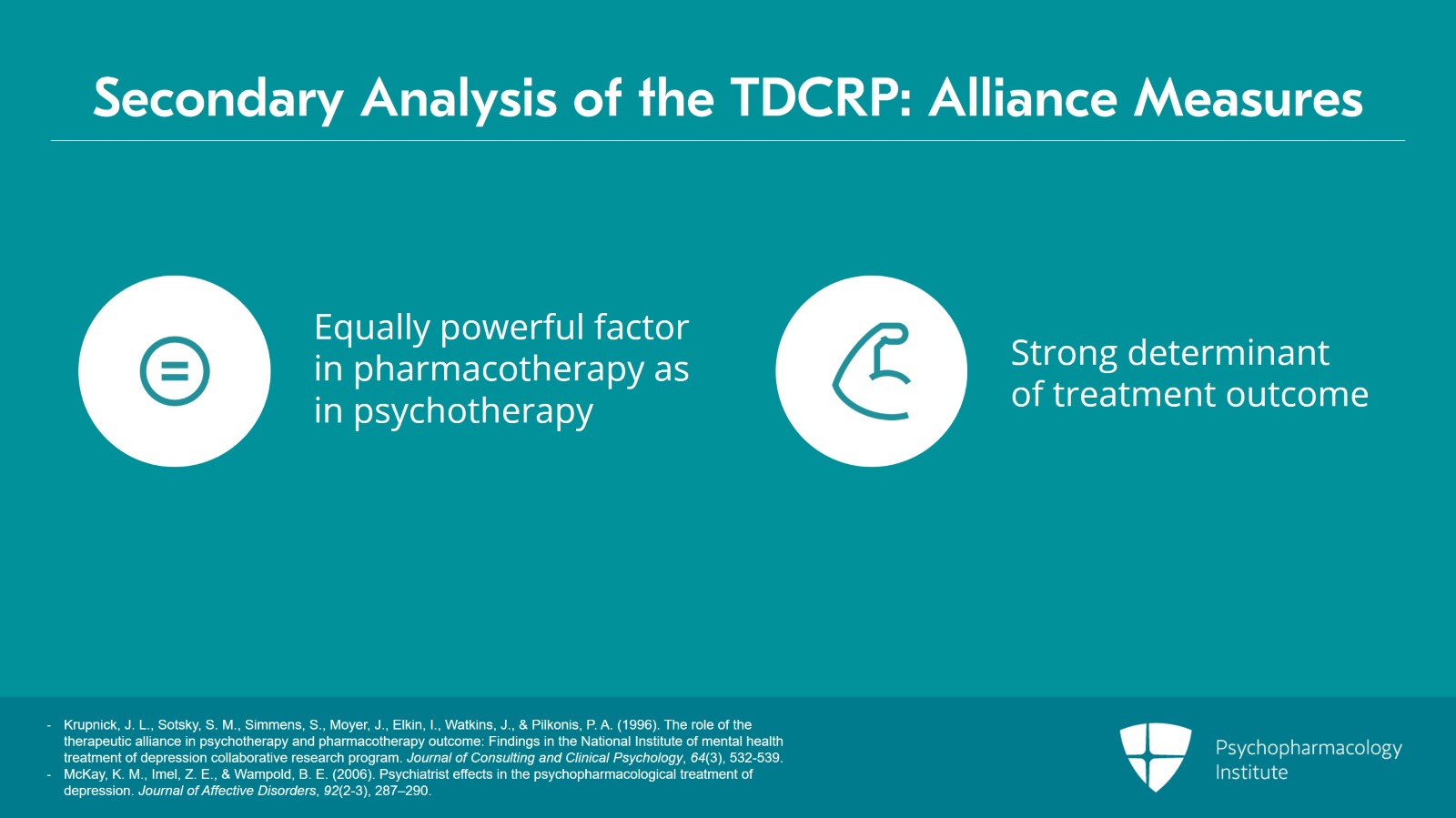
A study done, a secondary analysis of the TDCRP data which we've already discussed, the Treatment of Depression Collaborative Research Project which before STAR*D was the largest NIMH-funded, placebo-controlled, double-blind study that had been done, Krupnick et al. did a secondary analysis of that data looking through the lens of the alliance because they had obtained alliance measures in that study. And alliance, first of all, their experimental hypothesis was that alliance would be probably highly important in psychodynamic treatments, modestly important in CBT and, you know, marginally important in pharmacotherapy but it turned out that alliance was an equally powerful factor in pharmacotherapy as in psychotherapy and that alliance was actually a stronger determinant of treatment outcome than was drug condition.
References:
- Krupnick, J. L., Sotsky, S. M., Simmens, S., Moyer, J., Elkin, I., Watkins, J., & Pilkonis, P. A. (1996). The role of the therapeutic alliance in psychotherapy and pharmacotherapy outcome: Findings in the National Institute of mental health treatment of depression collaborative research program. Journal of Consulting and Clinical Psychology, 64(3), 532-539.
- McKay, K. M., Imel, Z. E., & Wampold, B. E. (2006). Psychiatrist effects in the psychopharmacological treatment of depression. Journal of Affective Disorders, 92(2-3), 287–290.
Free Files
Download PDF and other files
Success!
Check your inbox, we sent you all the materials there.
Slide 5 of 22
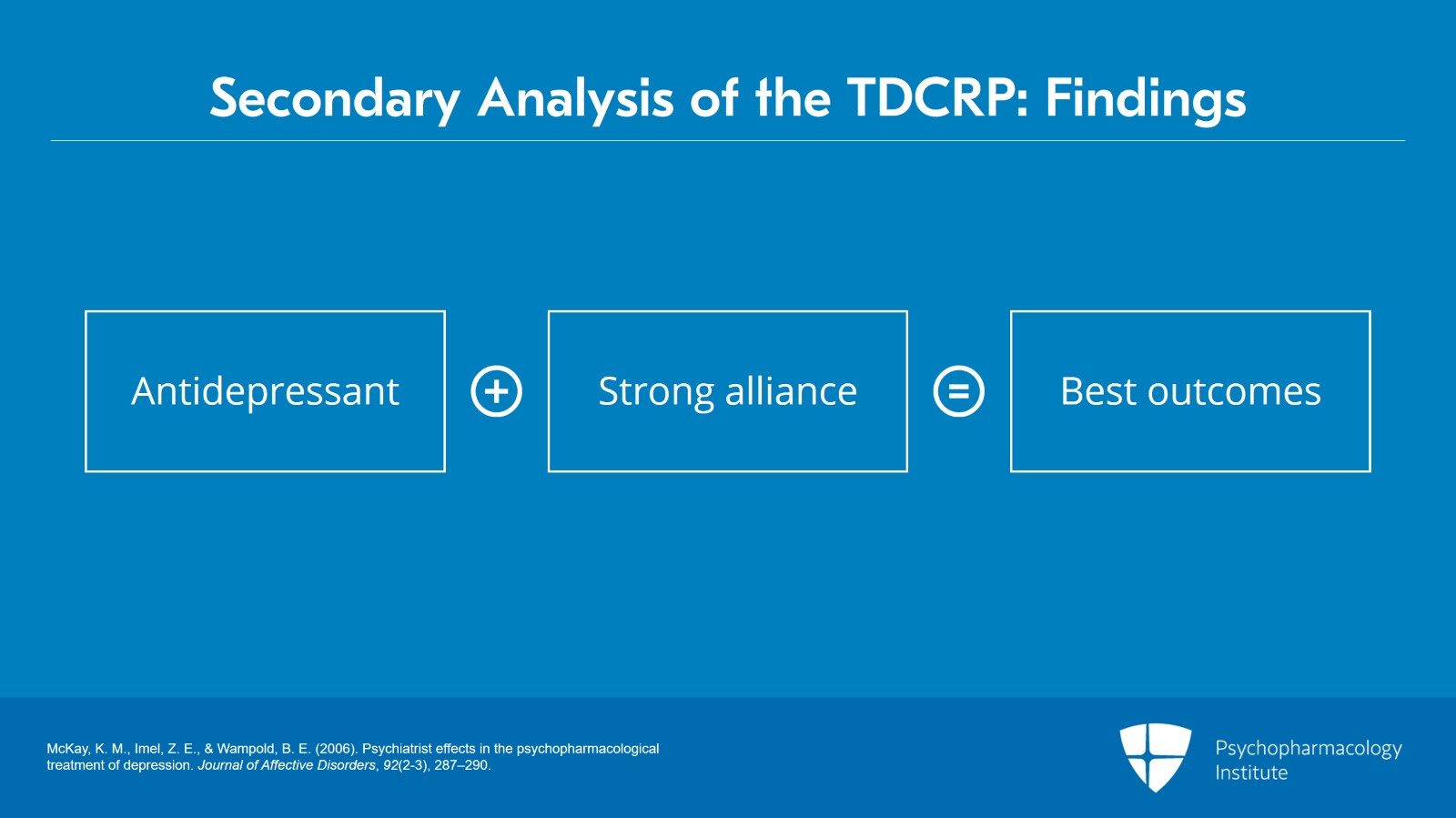
So in that study, and you probably know where I'm headed, the patients who got the active antidepressant and had a strong alliance with their doctor had the best outcomes.
References:
- McKay, K. M., Imel, Z. E., & Wampold, B. E. (2006). Psychiatrist effects in the psychopharmacological treatment of depression. Journal of Affective Disorders, 92(2-3), 287–290.
Slide 6 of 22
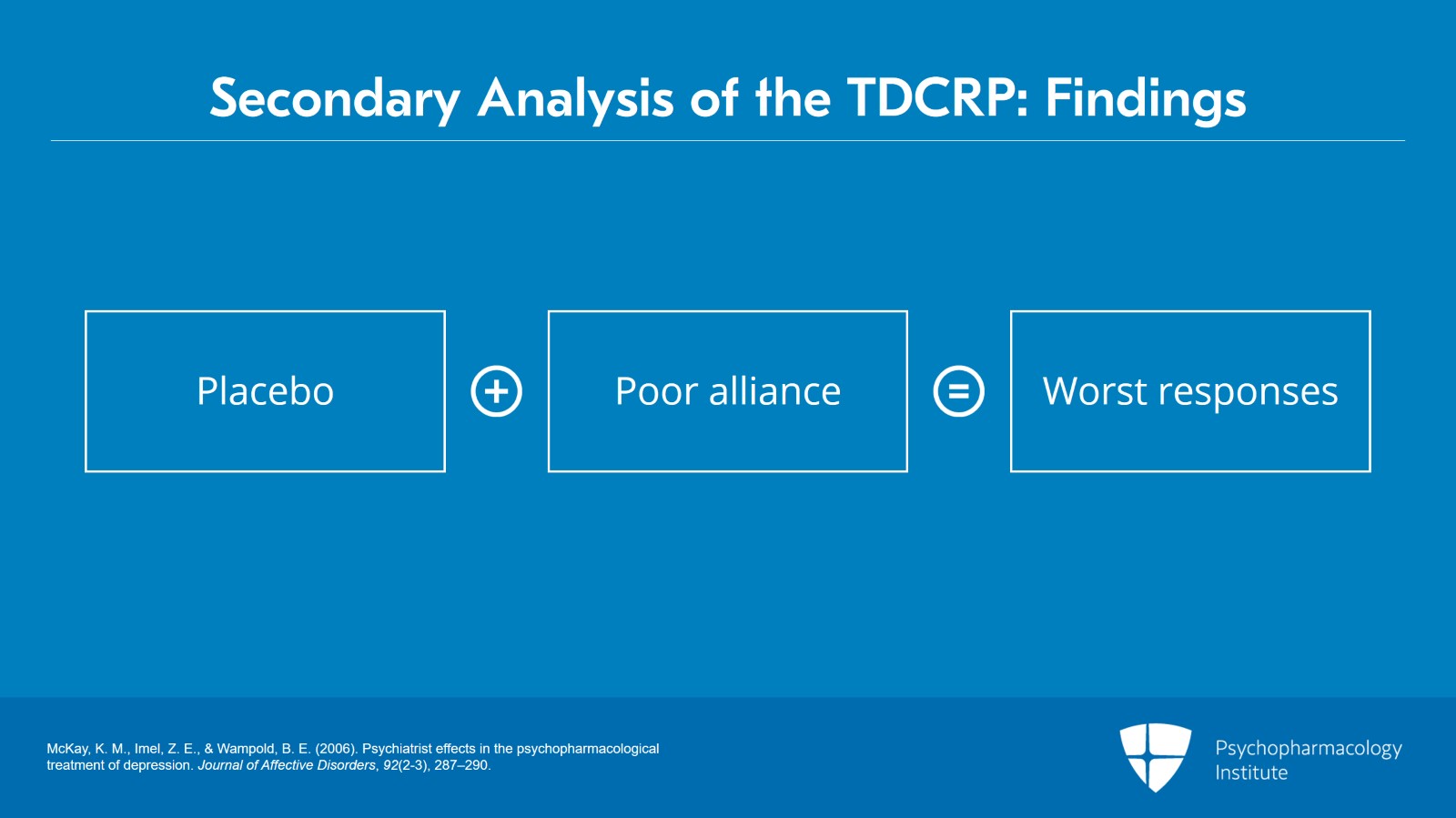
The patients who got the placebo and had a poor alliance with their doctor tended to have the worst response.
References:
- McKay, K. M., Imel, Z. E., & Wampold, B. E. (2006). Psychiatrist effects in the psychopharmacological treatment of depression. Journal of Affective Disorders, 92(2-3), 287–290.
Free Files
Download PDF and other files
Success!
Check your inbox, we sent you all the materials there.
Slide 7 of 22
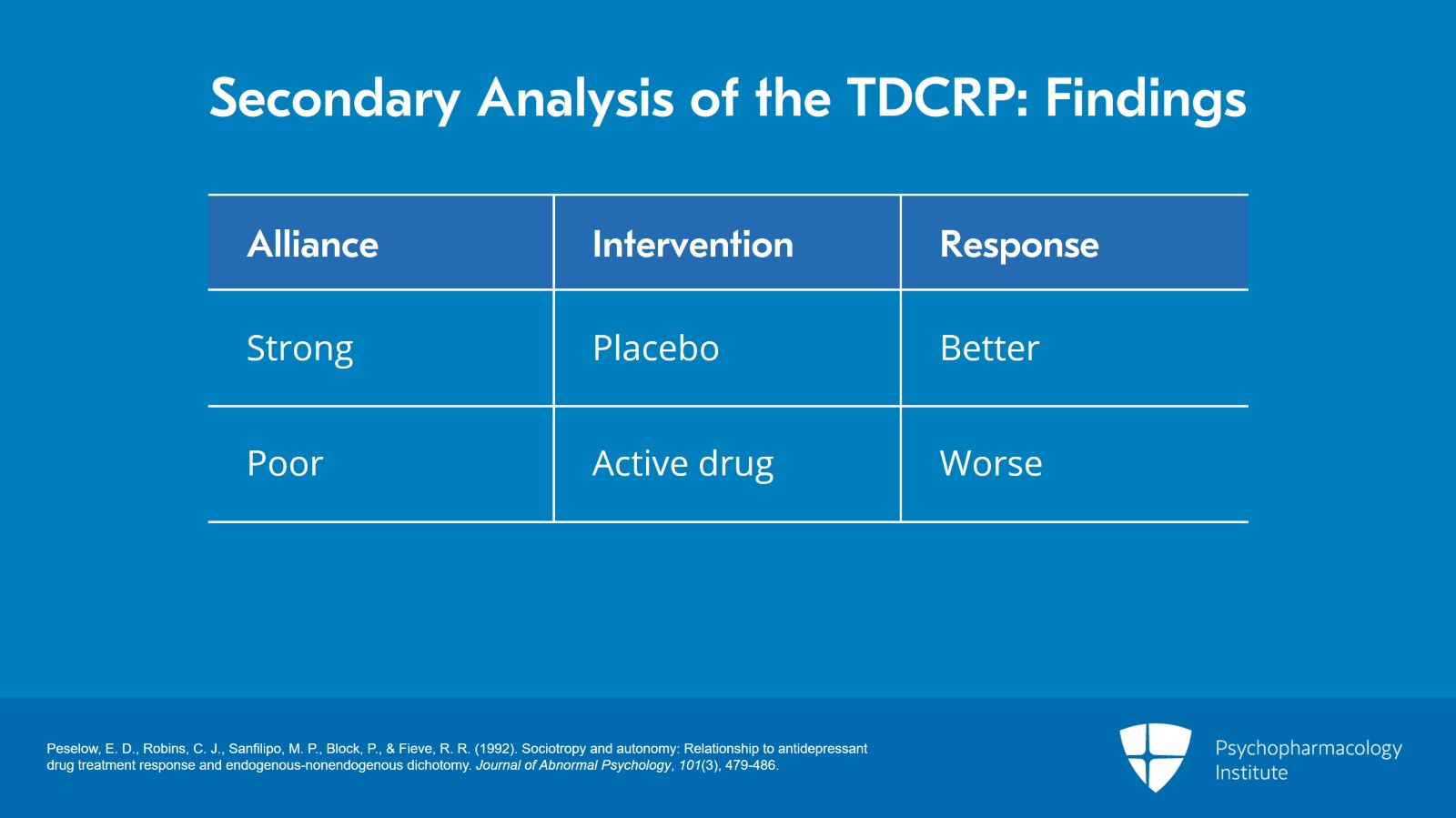
But in those two other cells, it was actually the patients who had a strong alliance with their doctor but got the placebo who had a better response than those patients who had a poor alliance with their doctor and received the active drug. So of course, one implication of this is, you know, that we really need to be attending to the quality of the doctor-patient alliance in our work with our patients.
References:
- Peselow, E. D., Robins, C. J., Sanfilipo, M. P., Block, P., & Fieve, R. R. (1992). Sociotropy and autonomy: Relationship to antidepressant drug treatment response and endogenous-nonendogenous dichotomy. Journal of Abnormal Psychology, 101(3), 479-486.
Slide 8 of 22
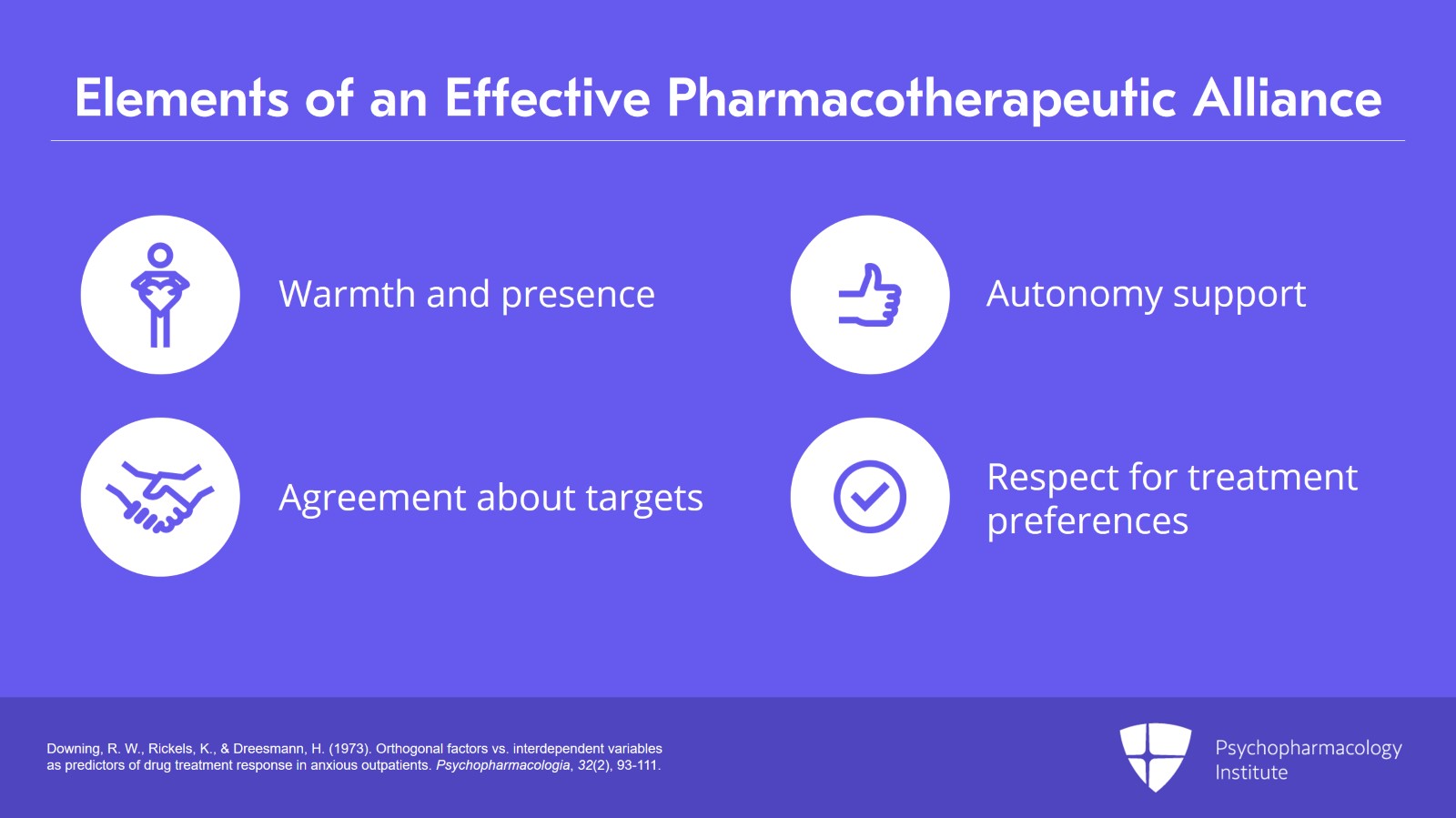
Now, to just talk about some of the elements of an effective pharmacotherapeutic alliance, there's warmth and presence, autonomy support, agreement about targets, respect for treatment preferences.
References:
- Downing, R. W., Rickels, K., & Dreesmann, H. (1973). Orthogonal factors vs. interdependent variables as predictors of drug treatment response in anxious outpatients. Psychopharmacologia, 32(2), 93-111.
Free Files
Download PDF and other files
Success!
Check your inbox, we sent you all the materials there.
Slide 9 of 22
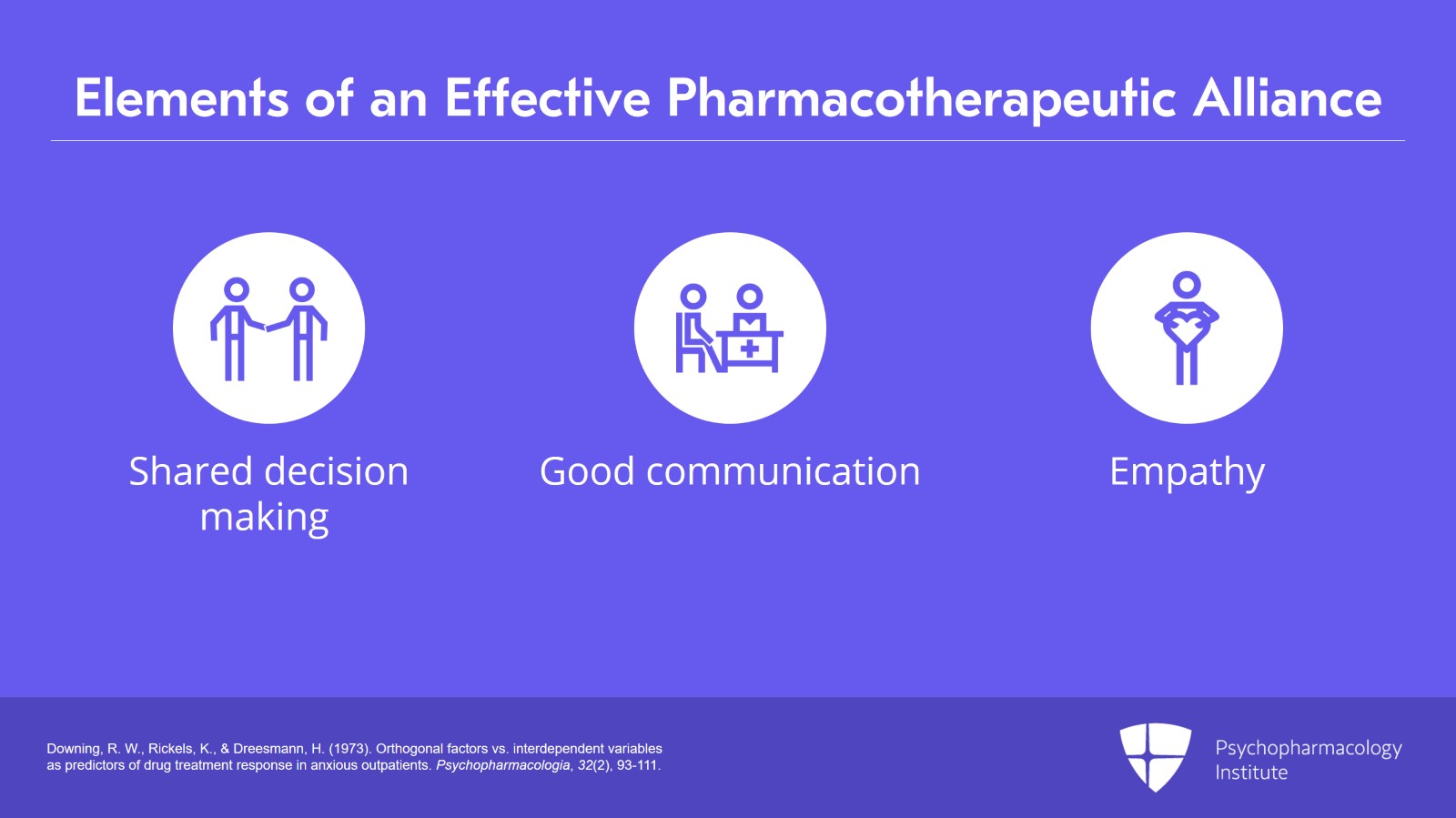
Shared decision making and good communication. And first of all, in terms of our own attitudes, we've known for, you know, a half century already that the level of empathy we experience towards our patients promotes positive outcomes.
References:
- Downing, R. W., Rickels, K., & Dreesmann, H. (1973). Orthogonal factors vs. interdependent variables as predictors of drug treatment response in anxious outpatients. Psychopharmacologia, 32(2), 93-111.
Slide 10 of 22
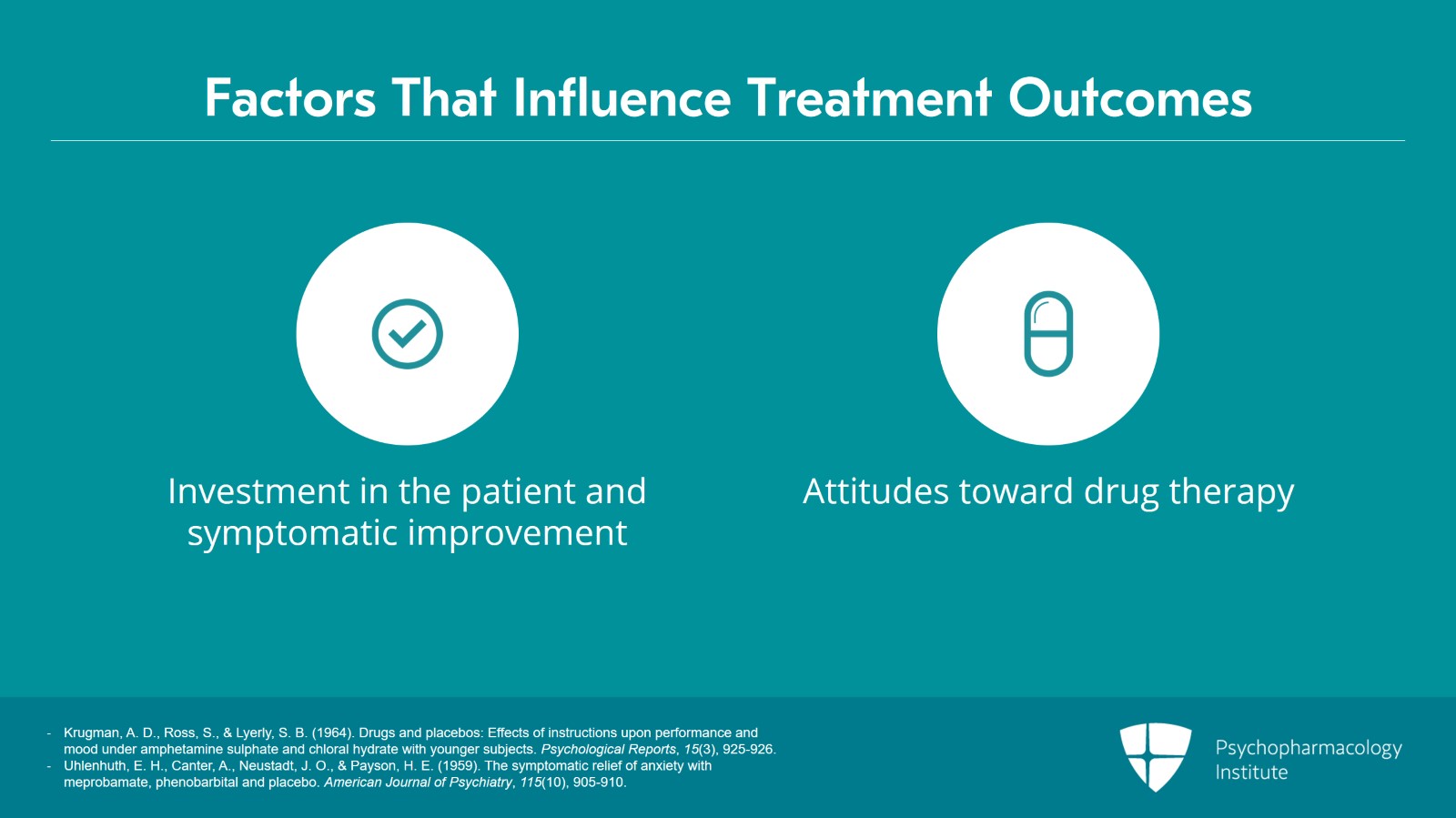
We know that our investment in the patient and their symptomatic improvement also influences treatment outcomes in a positive direction as do our attitudes towards drug therapy.
References:
- Krugman, A. D., Ross, S., & Lyerly, S. B. (1964). Drugs and placebos: Effects of instructions upon performance and mood under amphetamine sulphate and chloral hydrate with younger subjects. Psychological Reports, 15(3), 925-926.
- Uhlenhuth, E. H., Canter, A., Neustadt, J. O., & Payson, H. E. (1959). The symptomatic relief of anxiety with meprobamate, phenobarbital and placebo. American Journal of Psychiatry, 115(10), 905-910.
Free Files
Download PDF and other files
Success!
Check your inbox, we sent you all the materials there.
Slide 11 of 22
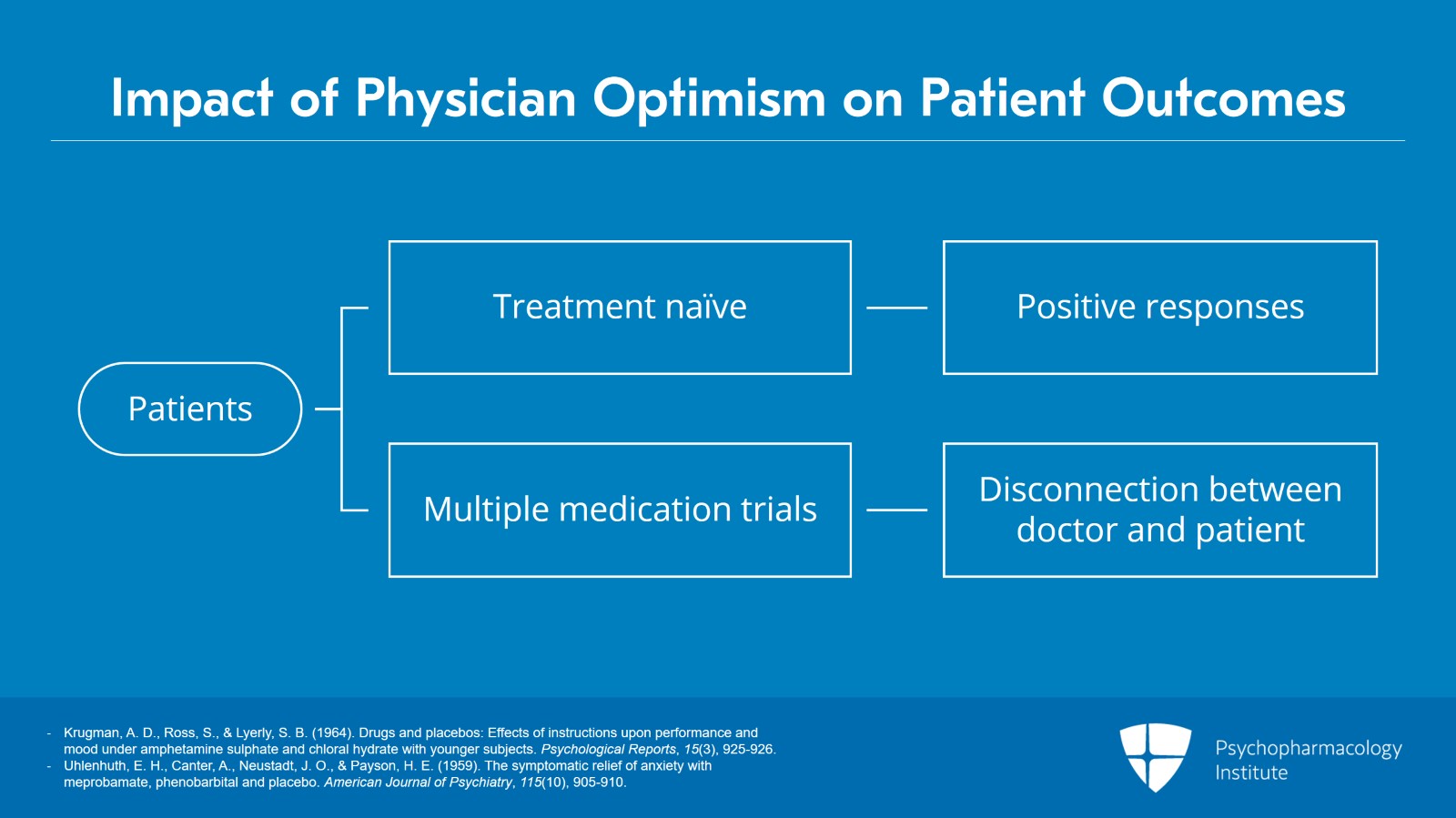
If we have very optimistic attitudes about drug therapy, patients who are treatment naïve tend to have positive responses. For patients who have already had multiple medication trials and have had inadequate responses, those patients actually do not like it when doctors are overly optimistic according to a study by Priebe and that optimism leads to a disconnect between doctor and patient rather than promoting positive outcomes.
References:
- Krugman, A. D., Ross, S., & Lyerly, S. B. (1964). Drugs and placebos: Effects of instructions upon performance and mood under amphetamine sulphate and chloral hydrate with younger subjects. Psychological Reports, 15(3), 925-926.
- Uhlenhuth, E. H., Canter, A., Neustadt, J. O., & Payson, H. E. (1959). The symptomatic relief of anxiety with meprobamate, phenobarbital and placebo. American Journal of Psychiatry, 115(10), 905-910.
Slide 12 of 22
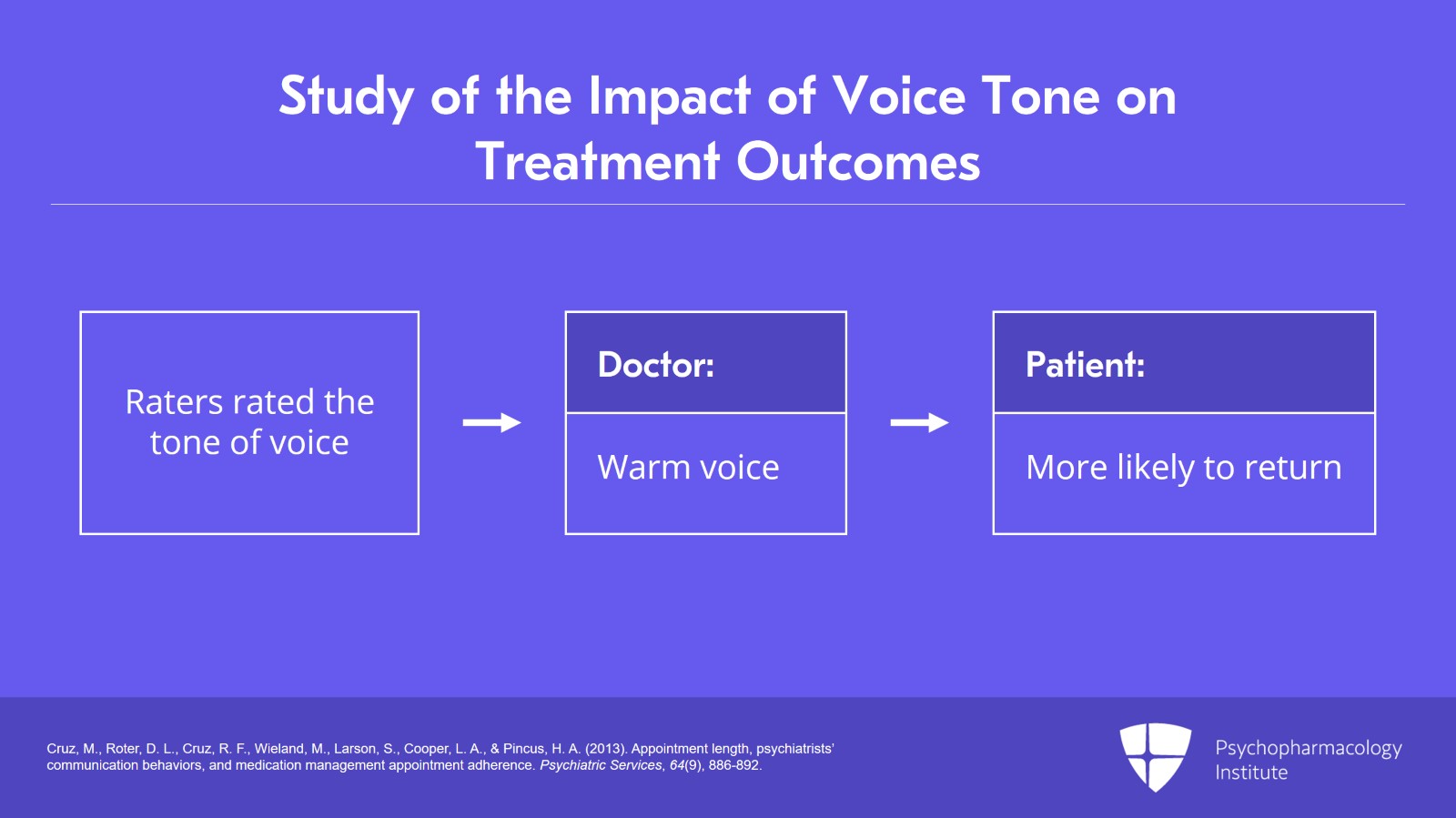
The value of warm human engagement cannot be underestimated. And an interesting study by Cruz in 2013 looked at the tone of voice and positive affectivity in the voice. So basically, they put a camera in an intake clinic for a mental health clinic and then had raters just rate the tone of voice of the intake person and there were a number of different intake people. And it turns out, and this is something you can get fairly high in the way of reliability on so you can kind of tell if somebody has a warm voice or not. So, if the doctor had a warm voice, the patient was far more likely to come back for a second appointment.
References:
- Cruz, M., Roter, D. L., Cruz, R. F., Wieland, M., Larson, S., Cooper, L. A., & Pincus, H. A. (2013). Appointment length, psychiatrists’ communication behaviors, and medication management appointment adherence. Psychiatric Services, 64(9), 886-892.
Free Files
Download PDF and other files
Success!
Check your inbox, we sent you all the materials there.
Slide 13 of 22
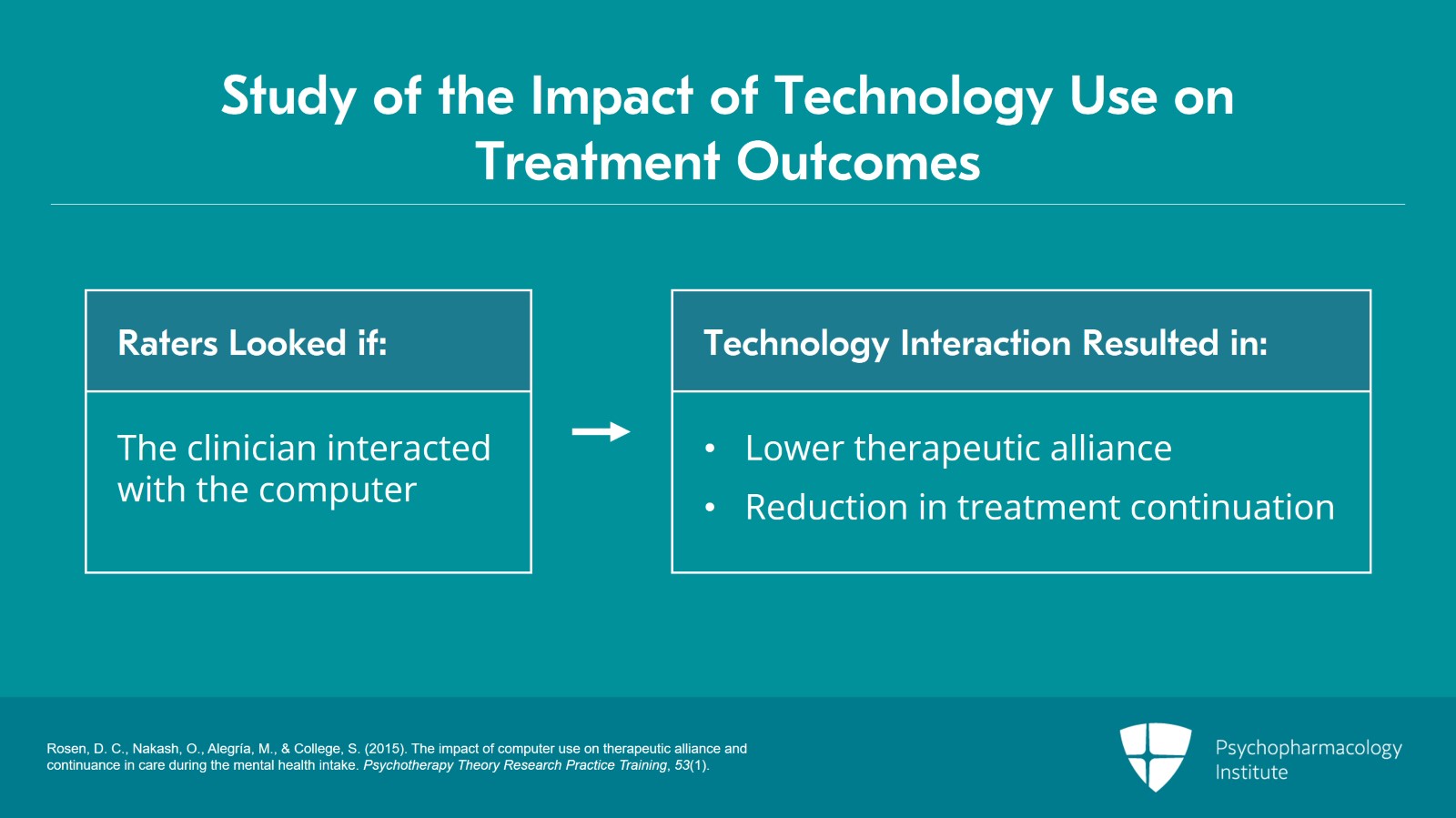
Similarly, technology use during intake assessment also seems to have a similar effect. So in this study, they put a camera in the intake. This is Rosen, Nakash and Alegria 2015. They put a camera into the room in which a psychiatric intake was being done and they had raters look at whether the clinician interacted with the computer or not. And if the clinician interacted with the computer once during that interview, that was coded as a session with technology interaction. And it turns out if there was any interaction with the computer that resulted in a lower therapeutic alliance and it resulted in a significant reduction in treatment continuation as well.
References:
- Rosen, D. C., Nakash, O., Alegría, M., & College, S. (2015). The impact of computer use on therapeutic alliance and continuance in care during the mental health intake. Psychotherapy Theory Research Practice Training, 53(1).
Slide 14 of 22
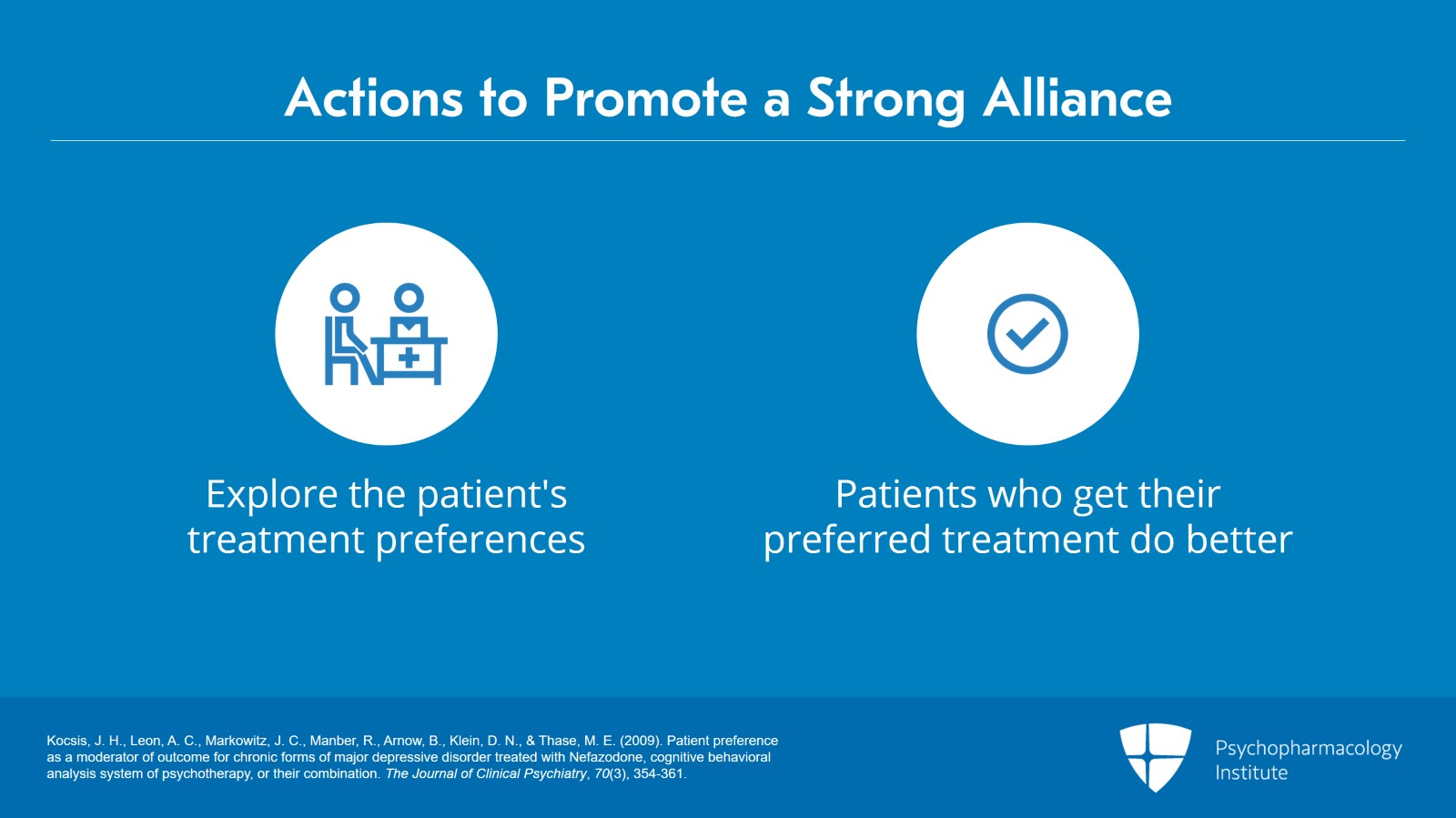
Now, some of the other things we can do in terms of promoting a strong alliance, certainly one of them is exploring and taking seriously the patient's treatment preferences. And it turns out that patients who get their preferred treatment modalities certainly do better. So if your patients are coming and want psychotherapy and you don't ask about this and simply move forward with prescribing antidepressants, that's a patient who's very unlikely to have a positive response. And so part of our assessments should be about patient's preferred treatments.
References:
- Kocsis, J. H., Leon, A. C., Markowitz, J. C., Manber, R., Arnow, B., Klein, D. N., & Thase, M. E. (2009). Patient preference as a moderator of outcome for chronic forms of major depressive disorder treated with Nefazodone, cognitive behavioral analysis system of psychotherapy, or their combination. The Journal of Clinical Psychiatry, 70(3), 354-361.
Free Files
Download PDF and other files
Success!
Check your inbox, we sent you all the materials there.
Slide 15 of 22
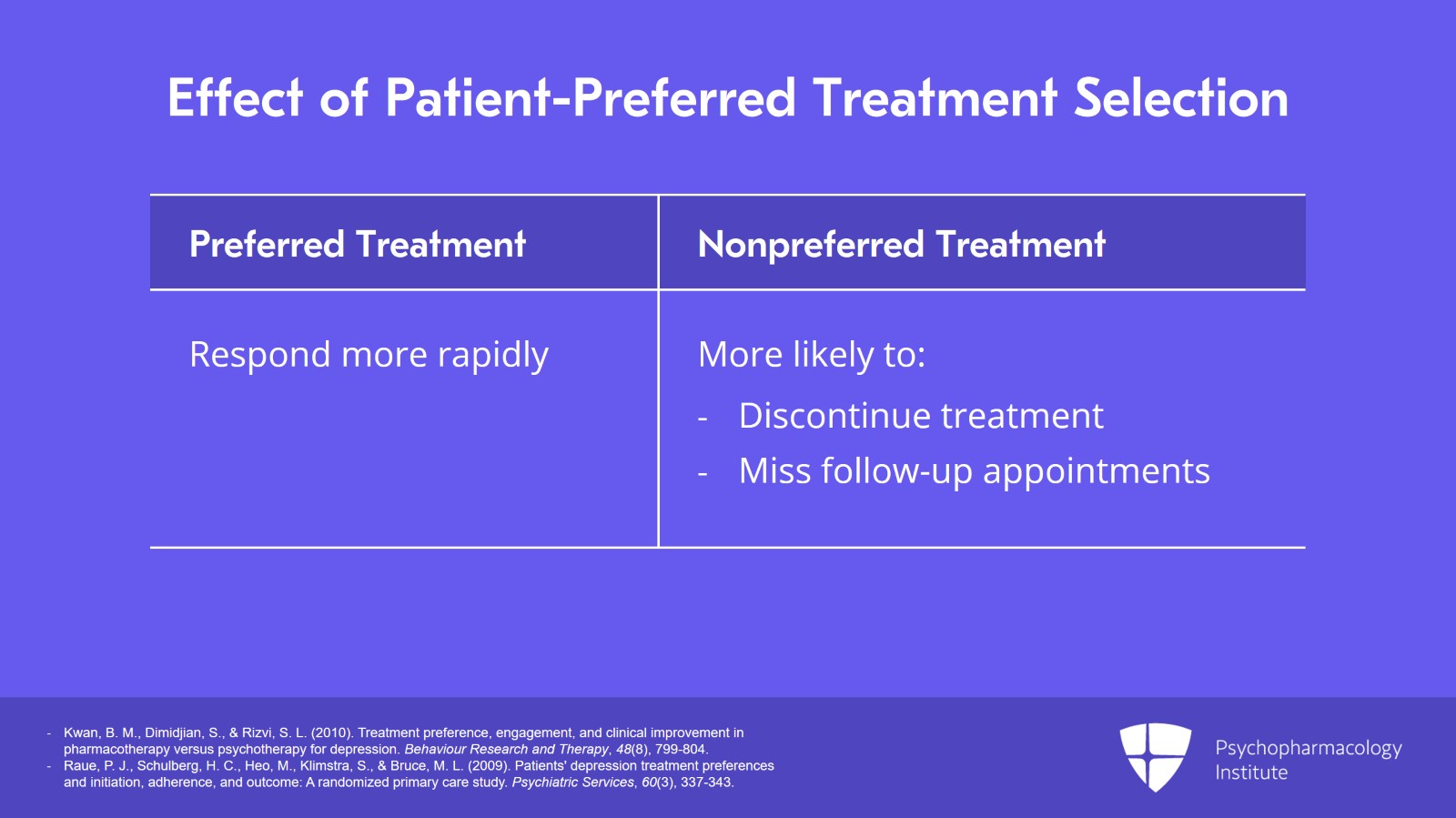
We know as well from a study by Lin et al. that patients who get their preferred treatment also respond more rapidly. Patients who are given a nonpreferred treatment are also more likely to discontinue treatment as well as to miss follow-up appointments.
References:
- Kwan, B. M., Dimidjian, S., & Rizvi, S. L. (2010). Treatment preference, engagement, and clinical improvement in pharmacotherapy versus psychotherapy for depression. Behaviour Research and Therapy, 48(8), 799-804.
- Raue, P. J., Schulberg, H. C., Heo, M., Klimstra, S., & Bruce, M. L. (2009). Patients' depression treatment preferences and initiation, adherence, and outcome: A randomized primary care study. Psychiatric Services, 60(3), 337-343.
Slide 16 of 22
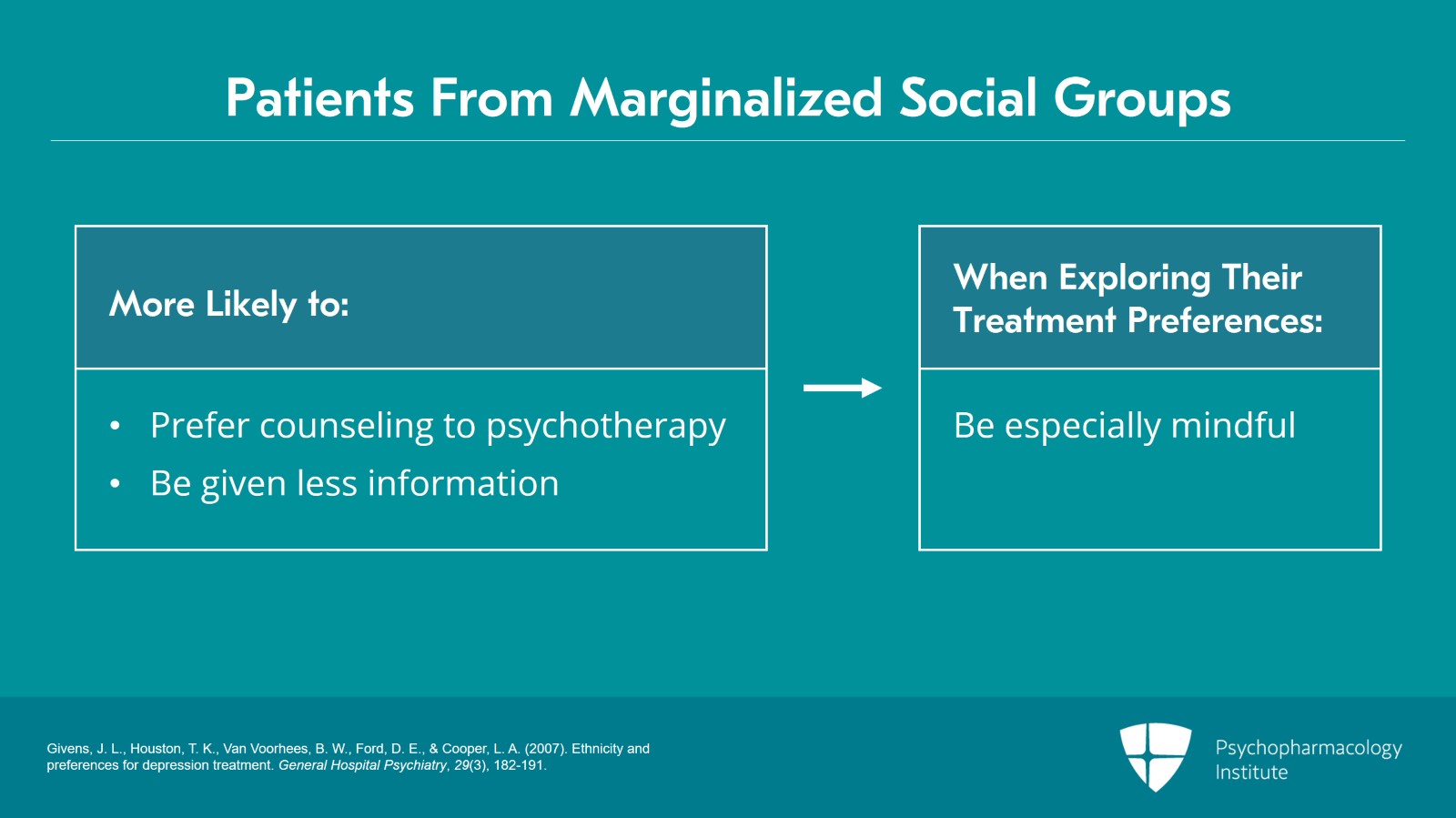
And important to recognize that patients from marginalized social groups as a whole are statistically more likely to prefer counselling to psychotherapy. However, they also tend to be given less information about treatment options and the physician communication style perpetuates patient passivity. So in terms of exploring treatment preferences, it is important of course with all of our patients but we need to be especially mindful with our patients who are from historically socially disadvantaged groups to be mindful that our own systemic biases may influence the degree to which we do that and so, you know, important for us to try to go in the opposite direction towards really particularly attending for the patient's treatment preferences.
References:
- Givens, J. L., Houston, T. K., Van Voorhees, B. W., Ford, D. E., & Cooper, L. A. (2007). Ethnicity and preferences for depression treatment. General Hospital Psychiatry, 29(3), 182-191.
Free Files
Download PDF and other files
Success!
Check your inbox, we sent you all the materials there.
Slide 17 of 22
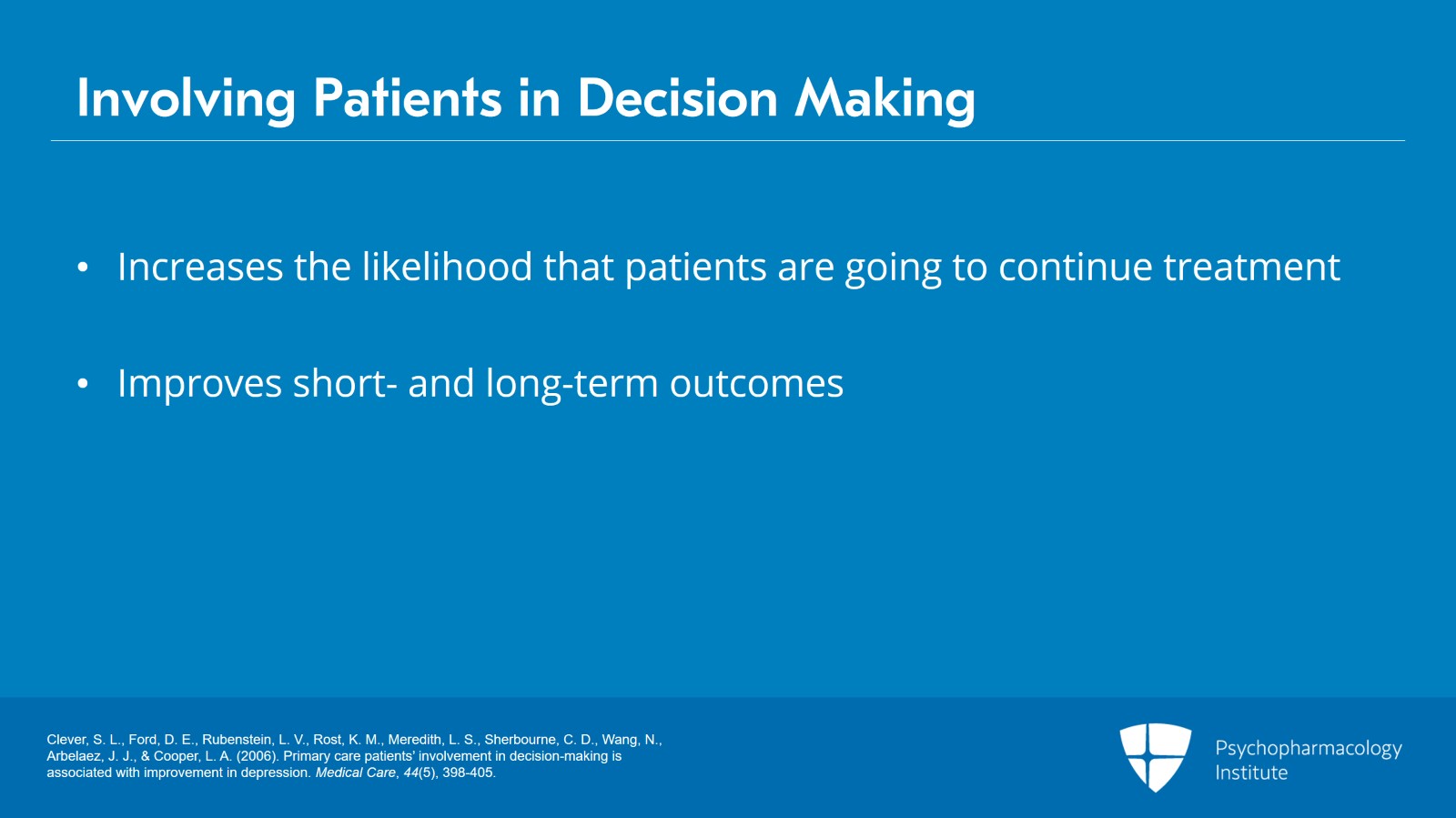
And when we involve patients in decision making, it makes it much more likely they're going to continue treatment. So an interesting study by Woolley et al. of patients hospitalized for depression in an inpatient psychiatric unit, patients were given a choice and this is really, it's really interesting, they were given a, a clinically meaningless choice but a choice. And the choice was, do you want to take your antidepressant once a day or three times a day? And just that increased the likelihood the patients who are going to continue treatment after discharge almost two and a half fold. And this has not just short-term implications but also long-term implications because studies also suggest that when we involve patients in decision making they're likely to have not just short-term improved outcomes but improved outcomes when measured 18 months out from the initial decision of initially giving them a role in deciding their own treatment.
References:
- Clever, S. L., Ford, D. E., Rubenstein, L. V., Rost, K. M., Meredith, L. S., Sherbourne, C. D., Wang, N., Arbelaez, J. J., & Cooper, L. A. (2006). Primary care patients’ involvement in decision-making is associated with improvement in depression. Medical Care, 44(5), 398-405.
Slide 18 of 22
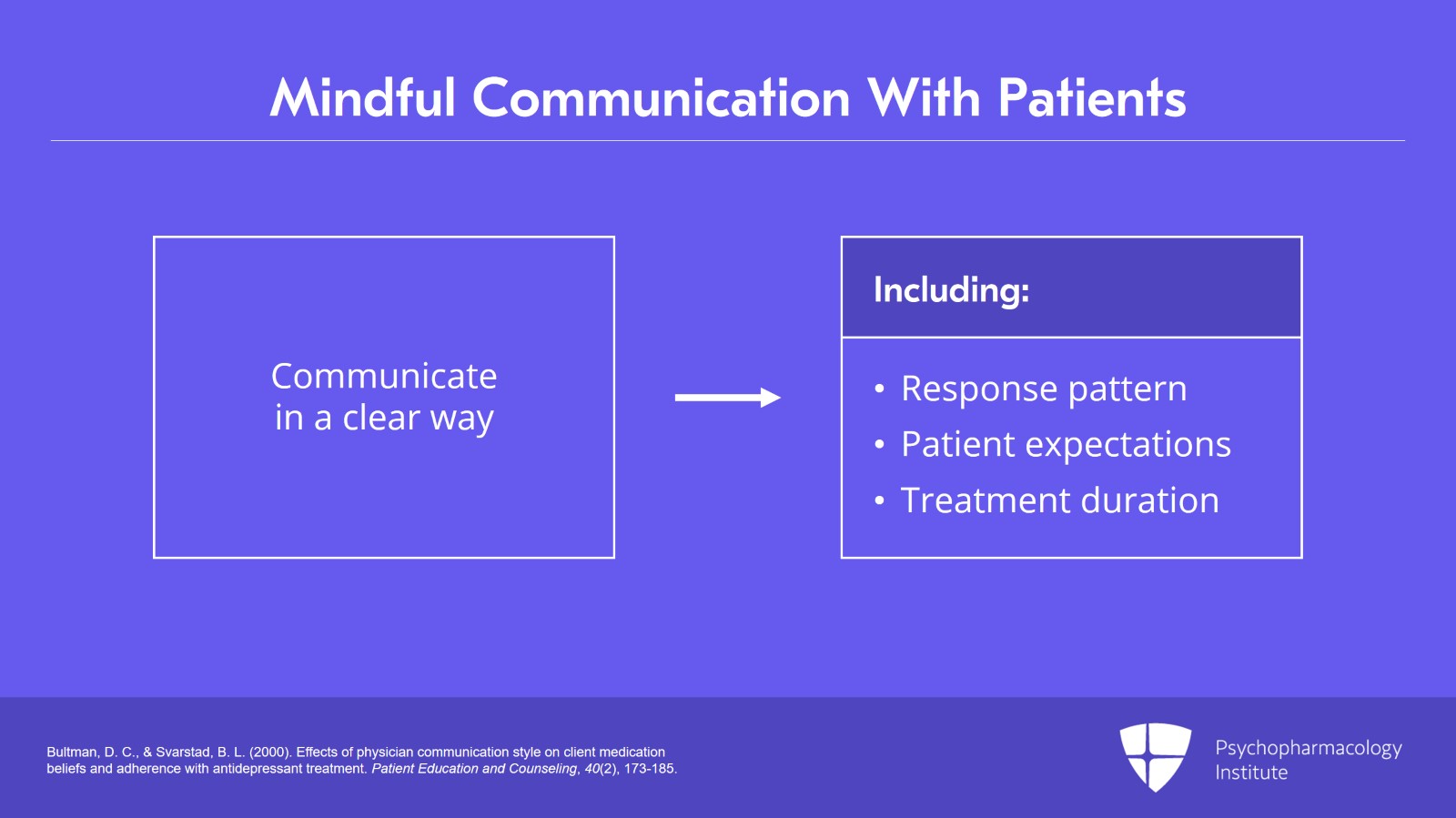
When we talk to our patients, that also seems to enhance outcomes and is an important part of the doctor-patient alliance so we should be mindful of communicating in a clear way that includes the response pattern, you know, what the patient can expect, when they can expect it, how long they should take their medications, you know, and what they might expect across time.
References:
- Bultman, D. C., & Svarstad, B. L. (2000). Effects of physician communication style on client medication beliefs and adherence with antidepressant treatment. Patient Education and Counseling, 40(2), 173-185.
Free Files
Download PDF and other files
Success!
Check your inbox, we sent you all the materials there.
Slide 19 of 22
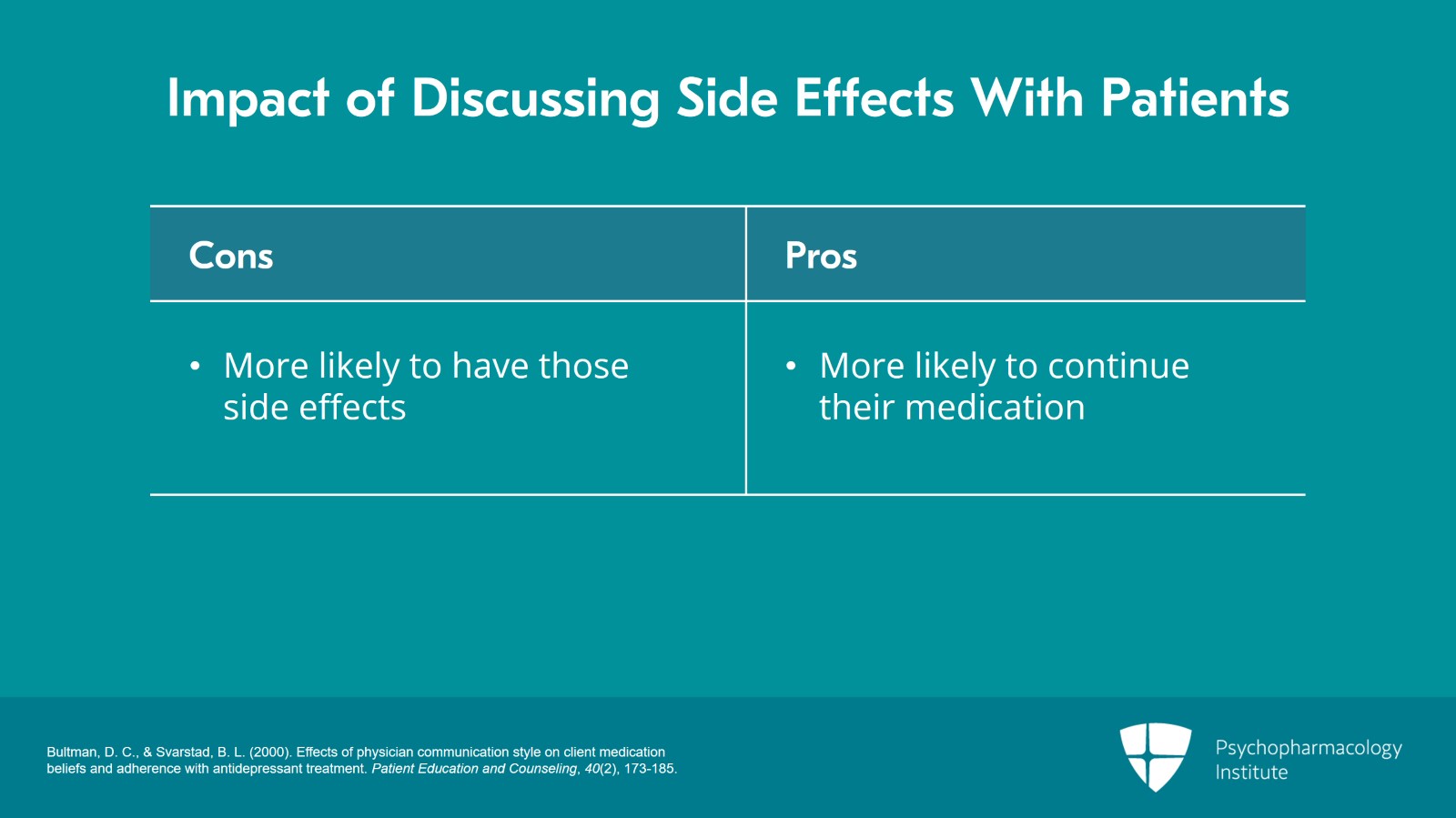
And also, the evidence is complicated around how much we tell our patients about side effects because when we tell our patients about side effects, they're more, more likely actually to have those side effects. But the research also suggests that when we have discussed those side effects ahead of time the patient is more likely to continue their medication in the face of a side effect. And so I think this argues for actually our being more thorough rather than less thorough about our side effect education of our patients.
References:
- Bultman, D. C., & Svarstad, B. L. (2000). Effects of physician communication style on client medication beliefs and adherence with antidepressant treatment. Patient Education and Counseling, 40(2), 173-185.
Slide 20 of 22
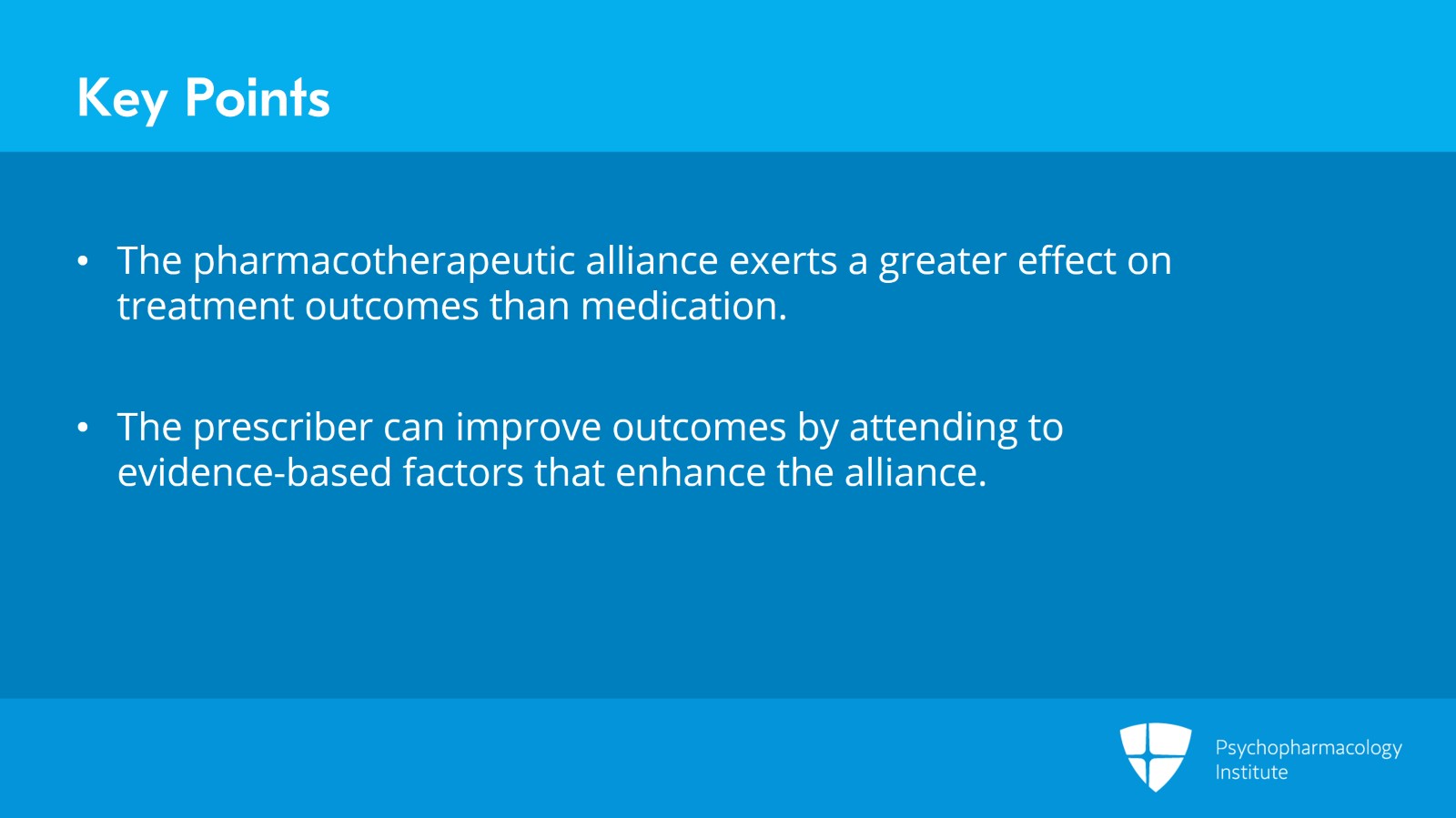
So to recap, pharmacotherapeutic alliance appears to exert at times a greater effect on treatment outcomes than the actual medications prescribed and this seems to be particularly clear in the treatment of depression. The prescriber can improve outcomes by attending to to evidence-based factors known to enhance the alliance.
Free Files
Download PDF and other files
Success!
Check your inbox, we sent you all the materials there.
Slide 21 of 22
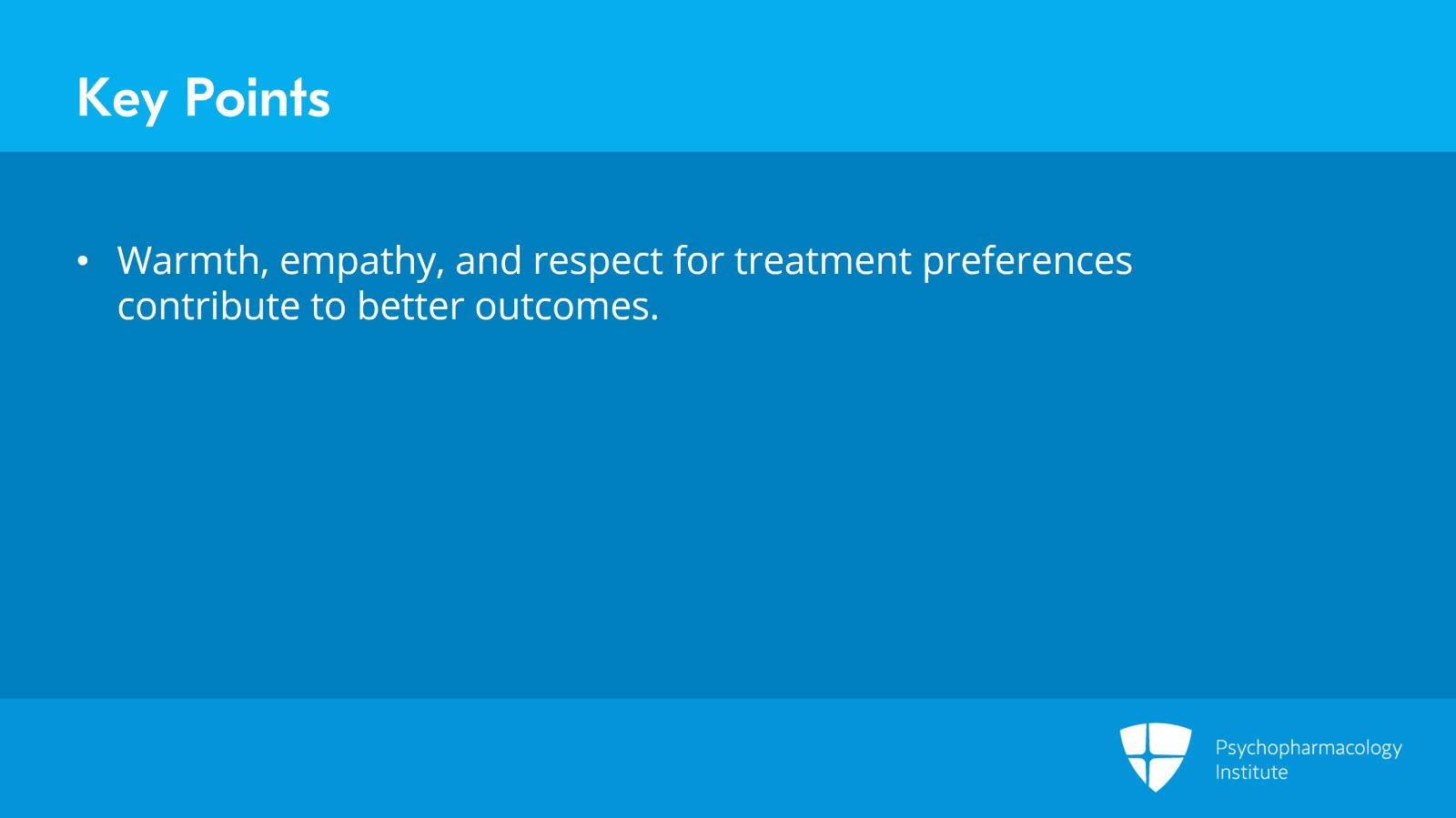
And warmth, empathy, and respect for treatment preferences while involving patients in medical decision making all contributes to better outcomes.
Free Files
Download PDF and other files
Success!
Check your inbox, we sent you all the materials there.